The Los Angeles Lakers Cost $12.5 Billion — 74 Times What They Earn
By TopHolding Editorial · Friday, August 21, 2026 at 12:44 PM
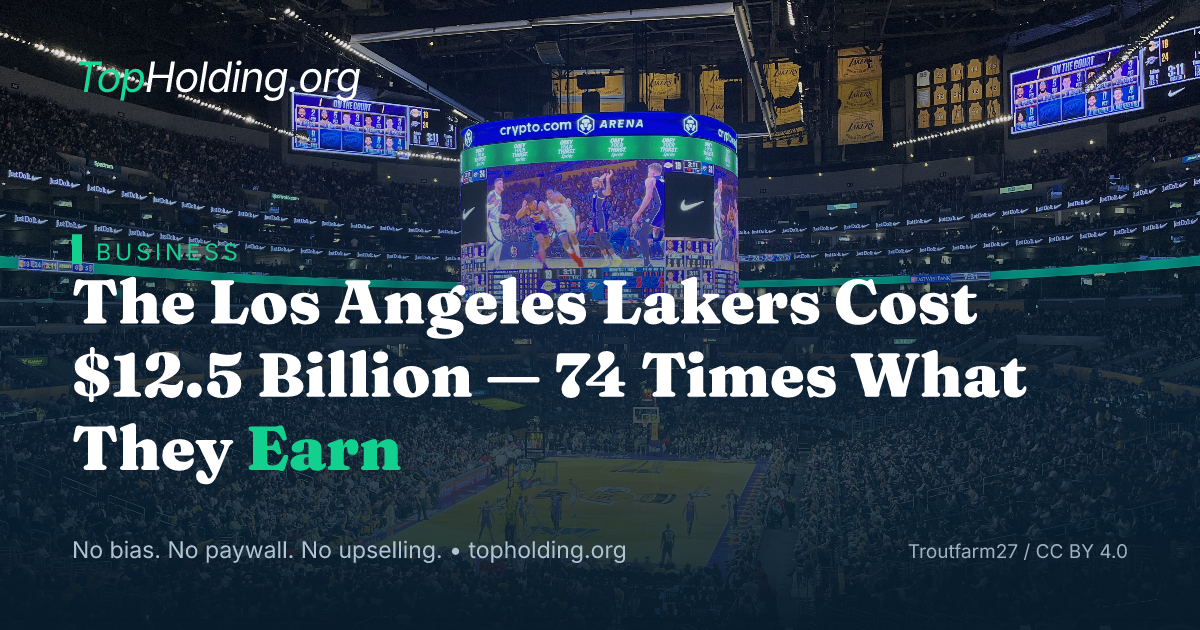
The Lakers just sold for the highest price ever paid for an American sports team. Their most recent published operating income was $170 million. The gap between those two numbers is not a mistake, and it explains more about how prices get set -- for teams, for houses, for anything scarce -- than the sale itself does.
On August 12, 2026, Josh Kushner and Bob Iger agreed to buy control of the Los Angeles Lakers at a valuation of $12.5 billion — the most anyone has ever paid for an American sports franchise.[1]
The last full set of published financials for the team, covering the 2024-25 season, shows revenue of $551 million and operating income of $170 million.[2]
So the price is roughly 23 times what the team collects in a year, and roughly 74 times what it keeps.
Neither number is a typo, and nobody involved is naive. Working out how both can be true is more useful than following the sale itself, because the same machinery sets the price of a house in a bidding war, a small business sold to the one competitor who wants its customer list, and anything else with more demand than supply.
The part that is ordinary business
Start with the piece that has a normal explanation.
In July 2024 the NBA signed 11-year media agreements with Disney, NBC and Amazon worth a reported $76 billion, running from the 2025-26 season through 2035-36. They replaced a nine-year, $24 billion deal.[3]
Divide each by its term and by the league's 30 teams and the shift is stark: national media money goes from roughly $89 million per team per year to roughly $230 million. That is our own arithmetic on the reported totals, and it is deliberately crude — real contracts ramp over their term and are not split perfectly evenly — but the order of magnitude holds.
An increase of about $141 million a year lands on a team that collected $551 million in 2024-25. It is worth a quarter of the Lakers' entire revenue, and it arrives without selling one additional ticket.
About half of it leaves again. Under the collective bargaining agreement, the players' designated share of basketball-related income is set by a formula that begins at 50 percent and is held between 49 and 51 percent, and the salary cap is calculated from projected league revenue.[4] Bigger television contracts mechanically raise what teams must pay players. Media money is not free margin. It is roughly half margin.
Run the generous version anyway. Give the Lakers the entire media increase on revenue and half of it on profit: revenue near $690 million, operating income near $240 million. The price is still about 18 times revenue and 52 times earnings.
The media deal explains why the number went up. It does not explain the number.
The same asset, priced twice
Here is the comparison almost nobody made.
The New York Knicks are the closest thing the Lakers have to a financial twin. Forbes puts the Knicks at $9.75 billion on revenue of $532 million and operating income of $98 million for 2024-25, and the Lakers at $10 billion on $551 million and $170 million.[2][5] Same league, same media contract, same kind of city.
The Knicks are also, unlike the Lakers, something you can buy on a Tuesday afternoon. They belong to Madison Square Garden Sports Corp., which trades on the New York Stock Exchange as MSGS. On August 20, 2026, the entire company carried a market value of about $9.62 billion — and that company owns the Knicks and the New York Rangers, on combined revenue of about $1.15 billion.[6]
Read the two prices next to each other.
One buyer paid $12.5 billion for a single basketball team. On the same day, the public market priced two franchises, one of them that team's near-twin, at under $9.62 billion of equity.
Why the two prices disagree
There are honest reasons, and they belong before the interesting one.
A share of MSGS buys no control. You cannot hire the coach, renegotiate the lease or sell the team. Control has always commanded a premium, and a whole-franchise sale is a control sale. Market capitalization also counts only equity; the price of the business itself is higher once net debt is added. MSGS is a corporation with corporate overhead and a hockey team attached, not a clean single-asset holding. And the Forbes figures for both teams predate the new media contract entirely. MSGS has also already run hard — its market value roughly doubled over the past year on the back of the Knicks' season.[6]
All of that narrows the gap. None of it closes it.
What remains is the part worth taking home: the two prices are produced by different machinery.
The public price is set continuously, by thousands of people, most of whom are asking what the business earns and what someone will pay them for it later. It has a floor and a ceiling built out of other people's opinions.
The private price was set once, in an auction with a handful of eligible bidders, none of whom needed the asset to pay for itself. There is one Lakers. It cannot be issued in greater quantity, it cannot be relegated out of the league, and the pool of people who can write that check and clear league approval is perhaps a few dozen worldwide. In a market that thin, price is not discovered. It is proposed, by whoever wants it most.
The velocity is its own evidence. Mark Walter bought control of the Lakers from the Buss family in 2025 at a $10 billion valuation. He is selling roughly a year later at $12.5 billion.[1] Twenty-five percent in about twelve months, on a business whose published earnings did not move anything like that far.
What this has to do with you
You are never going to buy a basketball team. You will almost certainly buy something priced the same way.
A house in a neighborhood with four listings and forty buyers is a thin market. So is a private company sold to a single strategic acquirer. So is any asset where you can count the plausible bidders on your fingers. In all of them, the transaction price tells you what the last buyer would pay — not what the thing produces.
Three things follow.
A price is not a valuation. "It sold for $12.5 billion" is a fact about one buyer. "It earned $170 million" is a fact about the asset. Treating the first as proof of the second is how people talk themselves into paying anything for anything.
Ask how many other buyers there were. The fewer plausible bidders, the less the price tells you. A deep, liquid market's price carries information. A one-bidder price carries a preference.
Ask what would have to be true. At $12.5 billion against $170 million of operating income, the buyers are not underwriting current earnings. They are underwriting the next media cycle, permanent scarcity, and the expectation that the following buyer pays more. That may prove correct. But it is the entire thesis, and it deserves to be said out loud rather than buried inside a multiple.
One last detail, because it is a tell. In the same stretch, MSG Sports filed to separate the Rangers business from the Knicks into two companies.[6] The usual reason to split a company in two is a belief that the market is not pricing its parts properly. Somebody else has noticed the gap.
Figures as of August 21, 2026.
This article is educational and is not financial advice.
Footnotes
- [1]Forbes, "Billionaire Josh Kushner, Former Disney CEO Bob Iger Buy Los Angeles Lakers In Record $12.5 Billion Deal," August 12, 2026 — $12.5 billion valuation; buyers Josh Kushner, founder of Thrive Capital, and former Disney CEO Bob Iger; seller Mark Walter, who acquired control from the Buss family in 2025 at a $10 billion valuation; described as the largest price ever paid for a U.S. sports franchise, above the $9.6 billion Seattle Seahawks sale earlier in 2026. ↩
- [2]Forbes NBA Team Valuations, Los Angeles Lakers — valuation of $10 billion calculated October 2025; revenue $551 million and operating income $170 million for the 2024-25 season, net of revenue sharing and arena debt service. ↩
- [3]CBS Sports, "NBA signs new TV deal: Details on 11-year, $76 billion deal with ESPN, NBC, Amazon," July 2024 — 11-year agreements totaling a reported $76 billion covering the 2025-26 through 2035-36 seasons, replacing a nine-year, $24 billion deal; approximately 2.6 times the prior annual national media revenue. ↩
- [4]The CBA Guide, "League Finances" — the players' designated share of Basketball Related Income is set by a formula beginning at 50 percent and held never below 49 percent and never above 51 percent; the salary cap is derived from 44.74 percent of projected BRI less projected benefits, divided by 30 teams. ↩
- [5]Forbes NBA Team Valuations, New York Knicks — valuation of $9.75 billion calculated October 2025; revenue $532 million and operating income $98 million for the 2024-25 season. ↩
- [6]Stock Analysis, Madison Square Garden Sports Corp. (NYSE: MSGS), data as of August 20, 2026 — share price $399.70, market capitalization approximately $9.62 billion, up 103.5 percent over the prior year; trailing-twelve-month revenue $1.15 billion; the company owns the New York Knicks and the New York Rangers and has filed a registration statement to separate the Rangers business from the Knicks. ↩