October Existing Home Sales Drop 5.5% to 3.750 Million Rate
By TopHolding Editorial · Wednesday, November 11, 2026 at 7:00 PM
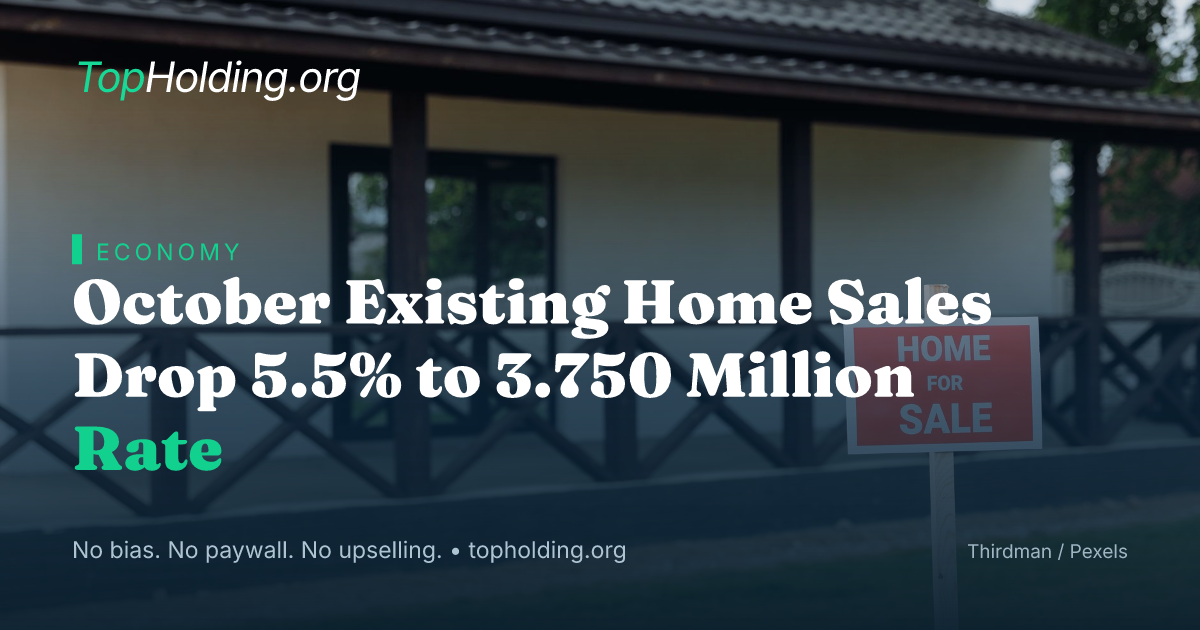
First Trust reports that October existing home sales declined 5.5% to a 3.750 million rate, their lowest level since 2010, driven down by rising mortgage rates and affordability constraints.
According to Bryce Gill, Economist, Brian S. Wesbury, Chief Economist, and Robert Stein, CFA, Dep. Chief Economist at First Trust Portfolios, existing home sales declined 5.5% in October to an annualized rate of 3.750 million units. This reading came in below the consensus estimate of 3.850 million, leaving total sales down 8.8% compared to a year earlier. Sales volumes fell across the West, South, and Midwest while remaining flat in the Northeast, reflecting drops in both single-family residences and condominiums. The median price of an existing home fell to $416,700 on an unadjusted basis, representing a 0.4% increase year over year.
The economists observe that October sales reached their lowest pace since 2010 as rising borrowing costs forced prospective buyers to stay on the sidelines. The team notes that the housing market has struggled to gain traction since the pandemic, with annual activity lingering near 4.000 million units, comparable to levels seen following the 2008 financial crisis. First Trust attributes worsening affordability to global conflicts boosting energy costs and inflation, which propelled 30-year mortgage rates to 7.5% in October. Furthermore, the report emphasizes that buyers should not anticipate near-term Federal Reserve rate cuts as central bankers have resumed monetary tightening.
Despite these headwinds, the analysts argue that supportive conditions are beginning to form. First Trust highlights that inventory has reached its highest level since the pandemic, helping ease the mortgage lock-in trend that kept owners from listing properties. Meanwhile, the months supply of available homes climbed to 5.1 in October, surpassing the five-month benchmark typical of a balanced market for the first time since 2015. Additionally, the economists point out that aggregate wage growth has outpaced home price gains since early 2025, which gradually aids affordability. Gill, Wesbury, and Stein conclude that "the fundamentals for a modest improvement in home sales from the current lows are starting to emerge."
Get the free Money Checklist
Plus one plain-English email a week. No bias, no paywall, no pop-ups. Unsubscribe anytime.
Key terms
1. Months supply: The number of months it would take to deplete current housing inventory at the prevailing sales pace.
2. Seasonally adjusted annual rate (SAAR): A statistical rate adjusted to remove normal seasonal fluctuations and projected across an entire year.
3. Mortgage lock-in: A condition where homeowners choose not to sell because their current mortgage rates are significantly lower than prevailing market borrowing costs.
Source: Bryce Gill, Economist, Brian S. Wesbury, Chief Economist, and Robert Stein, CFA, Dep. Chief Economist, First Trust Portfolios — Data Watch. Read the original at ftportfolios.com.